
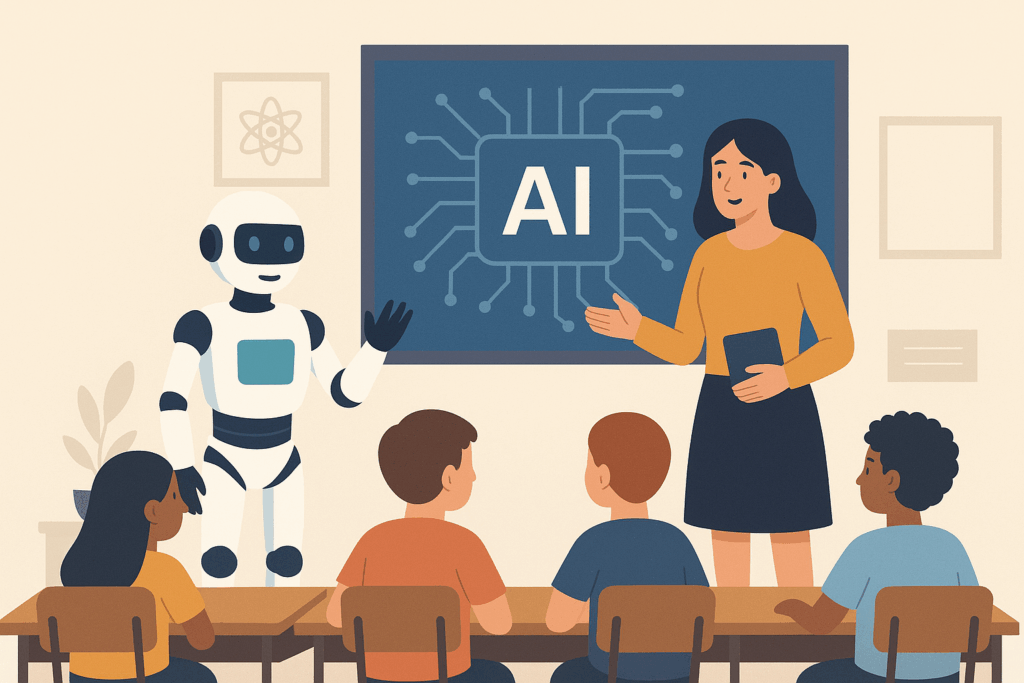
You cannot underestimate the rapid rise of artificial intelligence in various sectors of the economy in recent years. Having reshaped different industries worldwide, teachers can use AI in the classroom as well to automate tasks.
Artificial intelligence (AI) is changing how teachers plan lessons, manage classrooms, and support students. However, many teachers still don’t know how to use AI in a simple and practical way.
This guide will help you learn how teachers can use AI in the classroom, including tools, examples, and easy ways to get started.
Teacher Tech Zone provides practical guides to help teachers use technology effectively in the classroom.
What is AI in Education?
Before we look into AI’s role in the education space, it’s important to define this technology.
AI in education refers to the use of intelligent software and tools to support teaching and learning. These tools can help automate tasks, personalize lessons, and improve student engagement.
Instead of replacing teachers, AI acts as a support system that helps educators work more efficiently and effectively.
Ways Teachers Can Use AI in the Classroom
1.AI for Lesson Planning
Planning lessons can take a lot of time. You can use AI tools to generate ideas, outlines, and even full lesson plans in minutes.
For example, teachers can use AI tools to:
- Create lesson outlines.
- Generate quiz questions.
- Get teaching ideas for difficult topics.
This saves time and allows you to focus more on delivering quality lessons.
2.AI for Grading and Assessment
Grading and assessing learners can sometimes be such a daunting task. But you can use AI tools to automate parts of the grading process, helping make your work easier.
Teachers can:
- Automatically mark multiple-choice questions.
- Analyze student performance
- Get insights into weak areas
Besides reducing your workload, it also helps you to be more accurate, minimizing chances of making errors.
3.AI for Personalized Learning
Students come with unique needs and differences which sometimes can be difficult for teachers to pinpoint. It becomes a challenge for teachers to prepare lessons focused on all the learners unique needs. That’s why AI comes in handy.
AI helps teachers to tailor learning experiences to the needs of the learners, ensuring all learners are involved and have a fair chance of excelling.
With AI:
- Fast learners can move ahead
- Struggling students get extra support
- Lessons adapt based on performance
4.AI for Classroom Engagement
Keeping students engaged is one of the biggest challenges teachers face.
AI-powered tools can:
- Gamify lessons
- Provide interactive activities
- Offer real-time feedback
This makes learning more fun and effective.
This reflects our goal of making technology simple and accessible for teachers.
5.AI Tools for Student Support
Offering student support services can be an uphill task as learners have varied pressing issues affecting them. Teachers can use AI tools to support learners by:
- Providing students with course information
- Answering admission queries
- Offering student services
- Delivering reminders
Other AI chatbots can also help student to brainstorm ideas, enhance their writing skills and provide ample time to study.
6.AI Tutoring Systems
Since different students have unique needs, it might not be possible for them to achieve the same academic standards. Some of them may need tutoring in some subjects such as mathematics.
AI intelligent systems offer one-on-one experiences of working with a real tutor, enabling students to understand complex concepts.
AI in Classrooms in Kenya
In Kenya, AI is gradually being introduced to support the Competency-Based Curriculum (CBC). These tools help teachers personalize learning and reduce administrative workload.
Although adoption is still growing, AI has the potential to:
- Improve learning outcomes
- Support teachers in large classrooms
- Make education more accessible
Challenges of Using AI in Education
While AI offers many benefits, there are some challenges:
- Limited access to devices and internet
- Data privacy concerns
- Need for teacher training
These challenges highlight the need for proper implementation and support.
How Teachers Can Start Using AI Today
You don’t need advanced skills to start using AI. Here are simple steps:
- Start with basic AI tools for lesson ideas
- Use AI to create quizzes and assignments
- Experiment with one tool at a time
- Learn gradually and apply what works
The key is to start small and stay consistent.
Conclusion
AI is not here to replace teachers—it is here to enhance their capabilities. By using simple AI tools, teachers can save time, improve lesson delivery, and create better learning experiences for students.
The future of education is not about competing with AI, but learning how to use it effectively in the classroom.
Explore more guides and tools to improve your teaching using technology.